
Every political argument strains for a vivid image. For Donald Trump, the image is literal: white towers against blue sky, and a bald eagle nearby. In recent speeches and policy memos he has recast wind farms as not only an aesthetic or economic issue but an ecological and property-rights emergency—one that, if taken seriously by regulators, would substantially rearrange the risk profile for projects and their backers.
Trump’s framing picks two friction points—wildlife protection and private land rights—and fuses them into a regulatory wedge. He cites instances of raptor mortality linked to turbine blades and pairs those anecdotes with promises to broaden state and federal review of wind permits. The practical consequence is predictable: longer environmental reviews, more litigation, and higher upfront mitigation costs. For developers and institutional investors, the result is a higher discount rate on future wind-build returns and a shift in where capital flows.
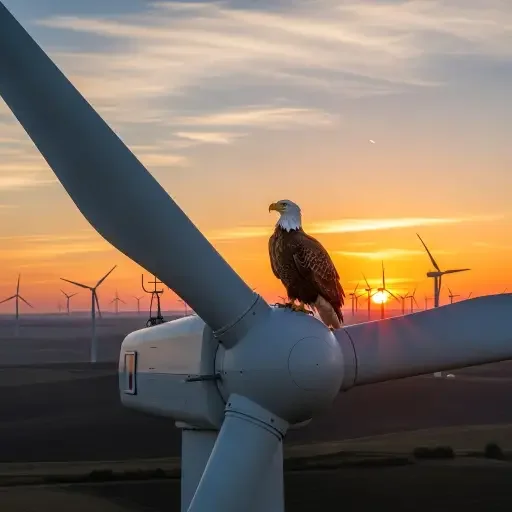
The claim about eagle fatalities is not novel—avian mortality at wind farms has been documented for decades—but the scale matters. Scientists estimate that, for most modern wind projects, bird deaths are small relative to other anthropogenic causes such as habitat loss, buildings, and vehicles. Yet bald eagles enjoy special legal status under the Bald and Golden Eagle Protection Act, which carries criminal penalties for intentional take and strict liability in some enforcement interpretations. That legal stick gives politicians leverage; reinterpreting enforcement or its thresholds can convert a statistical nuisance into a licensing knockout punch. A regulatory reinterpretation—say, lowering the threshold for what qualifies as a “take” or tightening incidental take permits—would force retrofits, operational curtailments, or outright cancellations.
Trump’s approach is deliberately asymmetrical. He is not proposing to ban wind energy across the board but to weaponize permitting friction where it most hurts: large-scale onshore projects sited near migratory corridors and nesting habitats. That has two strategic effects. First, it raises the marginal cost of new onshore capacity in politically sensitive jurisdictions, nudging developers toward offshore sites, smaller community projects, or other technologies. Second, it reallocates political capital: local landowners and courts become the gatekeepers of national decarbonization commitments. For capital markets, higher regulatory variance increases risk premia; lenders will demand stricter conditions, and tax-equity investors may walk until legal clarity returns. The near-term consequence is slower build rates and uneven geographic deployment—outcomes that increase the system cost of reaching emission targets.
Legal and bureaucratic levers are thin but potent. Agencies like the Fish and Wildlife Service and the Bureau of Land Management control permits, guidance and mitigation frameworks. Trump can influence these levers via executive orders, personnel appointments, or pressure campaigns that push agencies to reinterpret statutes or to prioritize enforcement. Litigation is a likely secondary field: developers can sue to block new restrictions, environmental groups can challenge rollbacks of protections, and states can file suit over federal overreach. The dance of suits, stays and injunctions would stall projects without resolving the underlying economic trade-offs.

Investors track two numbers: expected cashflows and the variance around them. A tighter regulatory environment increases both project-level costs (surveys, mitigation, time) and outcome variance (court decisions, permit revocations). Private-equity sponsors and infrastructure funds price that into hurdle rates; public utilities face ratemaking headaches when stranded or delayed assets enter the pipeline. Meanwhile, corporate buyers who count on renewable power purchase agreements to meet net-zero targets confront contractual and reputational risk if supply becomes less reliable. The capital response will be conservative: higher financing costs, more contractual contingency, and—critically—diversification away from jurisdictions with elevated political risk.
Framing energy policy as an ecological crusade has narrative potency, but it contains policy contradictions. Curtailing onshore wind accelerates reliance on fossil-peaked transitional generation or expedites expensive offshore builds. Offshore wind avoids many eagle conflicts but is costlier and slower; expanding fossil baseload increases emissions and undercuts climate commitments. There are also mitigation tools—blade painting, radar-triggered curtailment, micro-siting—that reduce mortality at manageable cost, but they require upfront investment and consistent regulatory standards. The policy trade-off reduces to a choice between short-term political wins and long-term energetic efficiency.
Trump’s pivot converts a narrow ecological concern into a strategic instrument of state-level power that reverberates through capital markets and corporate decarbonization plans. It is less a new energy policy than a re-pricing of uncertainty—like changing the interest rate on risk that the whole sector must now pay. Developers, lenders and corporate buyers must now price tighter permitting and legal risk into project models, pursue geographic diversification, and press for clearer, technology-aware mitigation standards from regulators.
If the debate ends at symbolism, wind will keep spinning; if it ends in stricter enforcement, investors should expect yield curves to compress for risky projects and legal fights to become the dominant unit of energy policy. Either way, the eagle has become a political fulcrum—and the financial architecture of renewables is the thing under strain.
Tags
Related Articles
Sources
Trump campaign statements and policy proposals; FWS and BLM regulatory documents; renewable energy industry analysis from trade publications; wildlife conservation research; wind project permitting data.