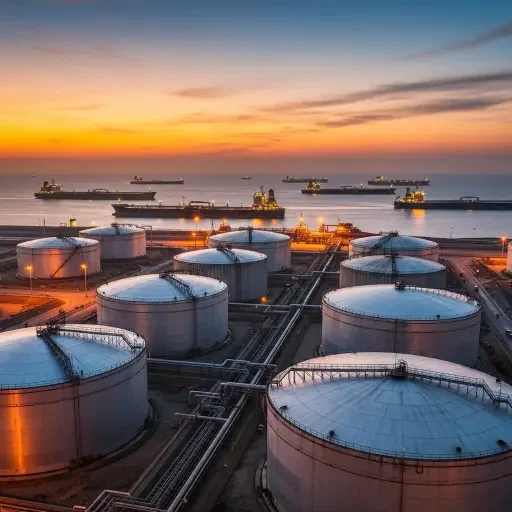
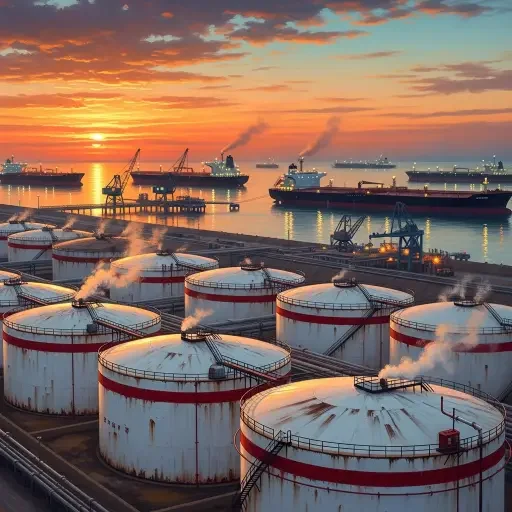
Iraq produced approximately 4 million barrels of oil per day in January. As of the first week of March, it has shut 1.5 million barrels of that daily output — 700,000 from the BP-operated Rumaila field, 460,000 from West Qurna 2, and 325,000 from the Maysan field. Iraqi oil officials told Reuters that those cuts could widen to more than 3 million barrels per day within days if the Strait of Hormuz remains closed to commercial shipping. That would represent roughly two-thirds of Iraq’s total production.
The Iraqi Cabinet has authorized the Ministry of Oil to exercise emergency powers to manage what it described as a potential crisis in crude and petroleum product exports. An Iraqi government adviser told Alhurra that Baghdad is only days from deciding to completely halt oil production for export from its southern fields. The constraint is not damage to the fields themselves. It is the simplest kind of industrial bottleneck: storage is full and there is no way to empty it.
The Chokepoint Math
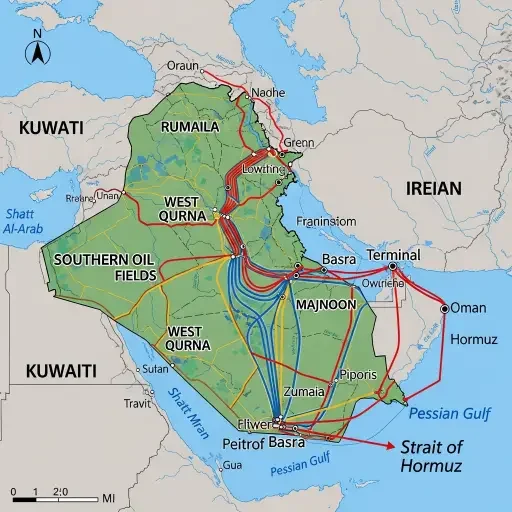
Iraq exports 97 percent of its crude through the Strait of Hormuz, loading tankers at southern terminals near Basra that feed into the Persian Gulf. When traffic through the strait dropped from roughly 24 tanker transits per day to effectively zero between February 28 and March 2, those terminals became dead ends. Tankers that would normally cycle through loading, transit, and delivery now sit at anchor, unable to move. Without tankers accepting cargo, port storage fills. When port storage fills, pipeline flow from the fields must be curtailed. When pipeline flow is curtailed, wells must be shut in.
Each link in the chain is mechanical, and the timeline is short. An Iraqi government adviser estimated that current food commodity stockpiles — flour, rice, cooking oil, legumes — are sufficient for about six months, but the Hormuz closure affects imports as well as exports. Vegetable and consumer goods prices are already rising, with imports from Turkey and Jordan unable to fully compensate for the lost southern maritime route.
Iraq Is Not Alone — But It Is First
Qatar ceased most of its LNG output on March 2 and declared force majeure on gas contracts by March 4. Kuwait has begun shutting production. S&P Global Ratings noted that 89 percent of Saudi Arabia’s energy exports flow through Hormuz; Saudi has begun redirecting modest volumes through its Red Sea port at Yanbu, but those flows cannot approach Hormuz-scale throughput. Japan, which obtains roughly 70 percent of its Middle Eastern crude through the strait, has asked its government to release stockpiled reserves.
Iraq’s situation is the most acute because its alternatives are the most limited. Saudi Arabia has the East-West Pipeline to Yanbu. The UAE has the Abu Dhabi Crude Oil Pipeline bypassing Hormuz to Fujairah. Iraq’s only non-Hormuz export route is the Iraq-Turkey pipeline, which has been offline since early 2023 due to a commercial dispute and has a maximum capacity of roughly 500,000 bpd even when operational — a fraction of what Iraq needs to move. Baghdad is functionally trapped.
The Structural Risk Is Reservoir Damage
Production shutdowns at this scale carry consequences beyond lost revenue. When large conventional oil fields like Rumaila are shut in, reservoir pressure dynamics change. Wells that have been flowing for decades cannot simply be turned off and on like a valve. Restarting production after an extended shutdown requires careful reservoir management to avoid water coning, pressure loss, and long-term decline in recovery rates. The longer the shutdown persists, the more expensive and technically complex the restart becomes.
Helima Croft, global head of commodity strategy at RBC Capital Markets, described the situation as what looks like the biggest energy crisis since the 1970s oil embargo. Qatari Energy Minister Saad al-Kaabi warned that if the war continues, other Gulf producers may be forced to halt exports and declare force majeure, adding that the consequences “will bring down economies of the world.” Iraq’s oil ministry has stated that the production cuts will not affect domestic refinery operations — refineries will continue processing crude for internal consumption. But for a country whose national budget depends overwhelmingly on export revenue, domestic refining is a life-support measure, not a solution. Iraq is not running out of oil. It is running out of places to send it — and every day the strait stays closed, the damage compounds.
Tags
Related Articles
Sources
Bloomberg Iraq production shutdown reporting (March 3), Reuters via BOE Report (Iraqi oil officials), Alhurra exclusive Iraqi government adviser interview, Fortune Gulf production analysis, Iraq Business News cabinet authorization, Kpler commodity analysis, NPR Strait of Hormuz closure reporting, Wikipedia 2026 Strait of Hormuz crisis entry, Business Standard Iraq field shutdown data