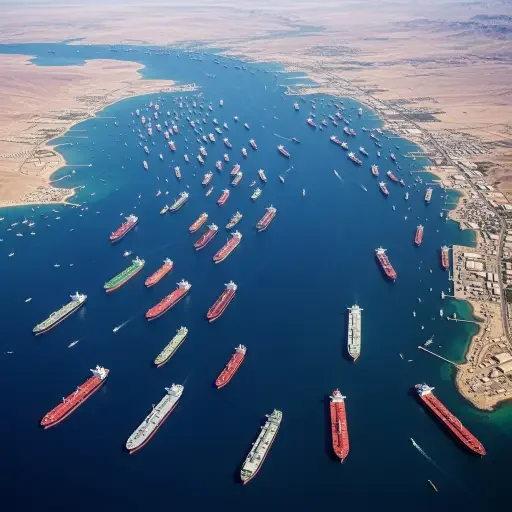
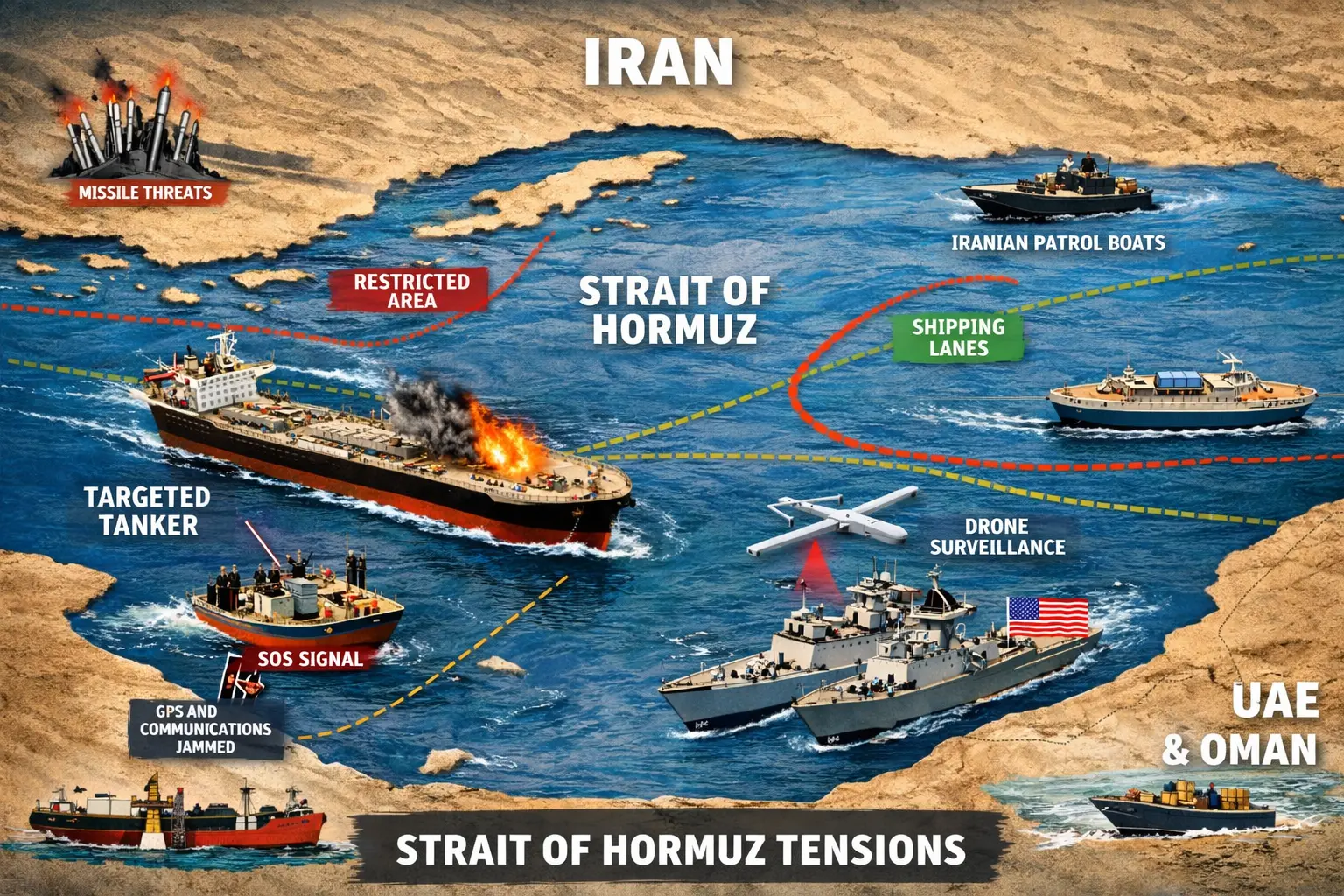
Every energy analyst had a model for a Hormuz closure. Nearly all of them assumed it would require Iran to lay mines, deploy its navy, or fire anti-ship missiles at tanker hulls. None of those things happened. Instead, Iran flew cheap drones near commercial vessels in the strait’s 21-nautical-mile bottleneck — and the global insurance market did the rest.
Within hours of Operation Epic Fury’s launch on February 28, the Islamic Revolutionary Guard Corps broadcast VHF warnings to every ship in the corridor: no passage permitted. The warnings carried no legal force — Iran never declared a formal blockade. But the IRGC didn’t need international law. It needed Lloyd’s of London to do the math.
Insurance, Not Ordnance, Closed the Strait
Maritime war-risk premiums had already climbed from 0.125% to 0.4% of hull value per transit in the days before the strikes. For a very large crude carrier worth $120 million, that meant a quarter-million-dollar surcharge on a single passage. When drone strikes landed near commercial shipping on March 1, the major protection and indemnity clubs pulled coverage entirely, effective March 5. Without insurance, no ship owner will sail. Without ships, 20% of the world’s daily oil simply stops moving.
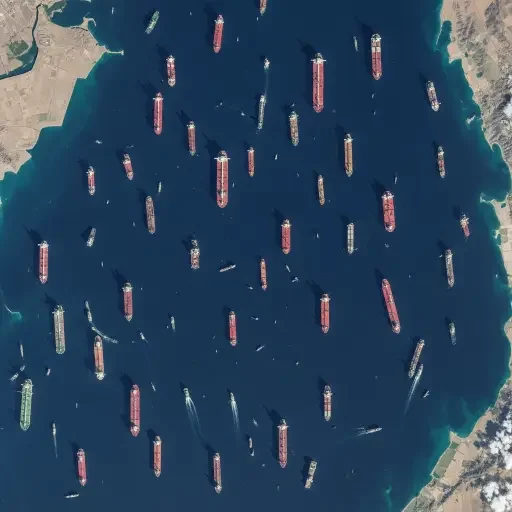
Ship-tracking data tells the story in brutal clarity. On March 1, only three tankers carrying roughly 2.8 million barrels crossed the strait — an 86% drop from the normal 19.8 million barrels. By March 2, the IRGC formally confirmed closure. As of March 5, Kpler intelligence reports dry-bulk transits down 91%, with approximately 706 non-Iranian tankers waiting in the region and the strait functioning as what maritime analysts have called “a parking lot.”
The Cascade: From Chokepoint to Global Shock
The mechanism is asymmetric in a way that military planners will study for decades. Iran spent perhaps tens of thousands of dollars on drone sorties. The resulting disruption has sent Brent crude surging past $85 a barrel — up roughly 13% from pre-war levels — while U.S. benchmark WTI settled at $81.01 on Thursday, its highest since summer 2024. European natural gas prices nearly doubled in three days, peaking above €60 per megawatt-hour. American gasoline prices have jumped 9% in a single week to $3.25 per gallon.
The downstream effects are compounding. Iraq has begun shutting down operations at its Rumaila oil field because tankers cannot leave the Gulf, eliminating storage capacity. Qatar’s Ras Laffan LNG complex — one of the world’s largest — went offline after Iranian drone strikes. Maersk and Hapag-Lloyd suspended all strait transits, while Houthi forces in Yemen resumed Red Sea attacks, forcing Suez Canal traffic onto the weeks-longer Cape of Good Hope route.
The cascading disruption is hitting Asian economies hardest. Japan depends on Middle Eastern crude for 87% of its energy imports. South Korea, which channels 68% of its oil through Hormuz, saw its Kospi index suffer a historic 12.1% single-day plunge before rebounding 9.6% the following session. India faces what analysts describe as a dual physical and financial shock, with over half its LNG imports and 60% of its oil arriving through the Gulf.
The Reversal Problem
Even if hostilities paused tomorrow, reopening Hormuz would not be simple. Helima Croft, head of commodity strategy at RBC Capital Markets, has compared the current situation to the worst energy crisis since the 1973 oil embargo. The U.S. International Development Finance Corporation has offered to backstop shipping insurance and provide naval escorts, but industry leaders remain skeptical. One Greek shipping executive told NPR that normal traffic won’t resume until companies are confident the passage is “genuinely safe” — not merely insured.
The deeper lesson is strategic. Iran demonstrated that a nation doesn’t need to match an adversary’s naval power to close a maritime chokepoint. It needs only to raise the actuarial cost of transit above the threshold of commercial tolerance. The world’s most critical energy artery was shut not by a fleet, but by a spreadsheet — and reopening it will require something no military operation can deliver: the return of underwriter confidence.
Tags
Related Articles
Sources
Al Jazeera live coverage, CNN reporting, NPR energy analysis, Kpler maritime intelligence, Windward Maritime AI daily reports, Bloomberg oil market coverage, Wikipedia 2026 Strait of Hormuz crisis article, CNBC Strait closure analysis, Marine Insight shipping reports