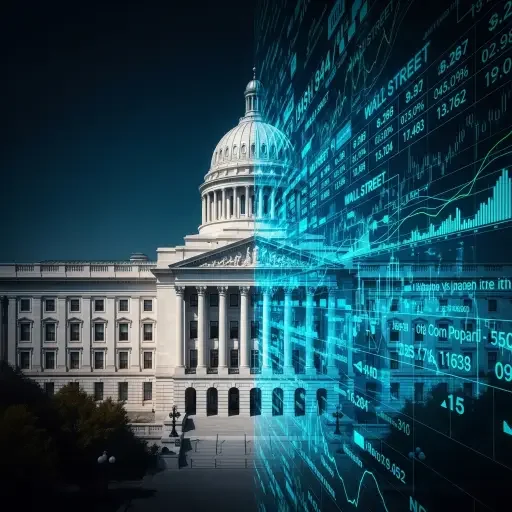
The Treasury’s pause on roughly $10 billion of federal transfers intended for Democratic-led states did not arrive as an isolated bureaucratic hiccup. It landed as an explicit signal—one that forced portfolio managers to mark-to-political-risk. Within days, municipal spreads widened, bank lending appetites shifted, and traders began to price in a higher, structurally persistent premium for policies tied to partisan enforcement.

What changed in practice: where investors previously treated governance shocks as temporary noise, the Treasury action reframed certain policy risks as endogenous to capital allocation. The market’s reaction is best read in three places simultaneously—municipal credit, trade-exposed equities, and regulated incumbents whose margins depend on administrative continuity.
States rely on federal flows to balance budgets; when those flows are uncertain, the default correlation between state tax revenues and federal aid rises. Credit analysts now model a bifurcated outcome set: one in which aid is restored and fiscal positions normalize, and another in which prolonged freezes force states into either spending cuts or new revenue measures that depress local growth. The result: a discontinuous pricing response. Long-duration municipal bonds have gained a discernible risk premium—spreads at the long end jumped several dozen basis points in the immediate aftermath—reflecting more than temporary liquidity worries. Portfolio managers with concentrated state exposure are rebalancing toward shorter-duration, higher-liquidity munis.

Trade-sensitive sectors are the second channel. Tariff rhetoric from political leaders—ranging from broad manufacturing levies to targeted duties on specific imports—has always been a volatility vector. Traders now append a nontrivial political option premium to companies with concentrated supplier bases overseas or material exposure to cross-border finished goods. The mechanism is simple: tariffs are not merely a tax; they are a regime change on profit margins. For import-heavy retailers and intermediate-goods manufacturers, models that once relied on stable trade assumptions now include a convex loss term tied to tariff probability. That convexity is being expressed in higher hedging costs, wider credit spreads, and lower multiple support for earnings-sensitive equities.
The third channel is regulatory and judicial risk. A pending Supreme Court case that could narrow administrative deference—if decided in favor of a stricter reading of judicial review—would raise regulatory uncertainty for sectors dependent on agency discretion: financial services, healthcare, and energy. Investors price not just the direct legal outcome but the second-order effect: more frequent litigation, slower rule-making, and shorter-lived regulatory certainty. In capital markets terms, that raises the cost of capital for firms whose business models depend on stable, predictable enforcement.
Those three channels interact. A state facing a prolonged freeze may respond with trade policies to shore up local manufacturing; a tariff shock can push firms toward restructuring that changes municipal tax bases; a court decision amplifying judicial scrutiny can render previously reliable regulatory relief ephemeral. The signal is systemic: policy moves are not siloed micro-events but networked shocks that propagate through capitals and contracts.
For portfolio construction the implications are concrete. First, mean-variance frameworks should incorporate a political-factor covariance matrix. Traditional factor models—value, momentum, size—do not capture the covariance between Treasury action, tariff risk, and judicial tendencies. Second, liquidity buffers matter more: in a world where federal aid can be paused, state revenues—and the securities backed by them—become conditional. Third, scenario-based stress tests should assume persistent partisan enforcement as a base case rather than an extreme tail event.
Risk premia are adapting along political geography. Blue-state long-duration munis carry more spread than their red-state counterparts on similar fundamentals, reflecting asymmetric policy risk. Conversely, companies that derive resilience from decentralized supply chains or domestic sourcing have seen relative cheapening—investors reward operational hedges. Active managers with on-the-ground fiscal intelligence can extract alpha by identifying states with credible legal recourse or diversified revenue mixes.
Legal counsel and policy strategists, not just credit analysts, are now first-order contributors to investment decisions. Firms with clear legal pathways to challenge federal freezes or with contingency contracts that limit tariff exposure trade at premium valuations. The market is differentiating between firms and municipal issuers that possess procedural armor and those that do not.
This reweighting is not without cost. Higher risk premia depress valuations and can constrict investment in public goods: infrastructure projects, social programs, and long-term capital formation that rely on low-cost borrowing. The political economy feedback loop is perverse—if markets demand higher yields for state borrowing, states may cut productive spending, worsening long-term growth and further damaging creditworthiness.
Two modest rules of thumb for investors: (1) price in directional political persistence—expect enforcement to follow electoral incentives until there is a clear institutional countervailing force; (2) treat legal outcomes as binary risk multipliers rather than smooth drifts. Hedge selectively: duration reduction in muni portfolios, option-based hedges for tariff exposures, and insurance or covenant-based protections in credit structures.
The Treasury freeze and the surrounding chatter are a market lesson: policy uncertainty can migrate from episodic headline risk into an enduring component of the cost of capital. Investors who continue to treat these signals as transitory will find themselves undercompensated for an emerging, politically fractured risk landscape.
In other words: the calendar for returns now keeps a political dial. Capital allocators who read that dial—who map legal routes, supply chains, and fiscal resiliencies—will be the ones to convert political noise into measured opportunity.
Tags
Related Articles
Sources
Public Treasury notices, market pricing data, municipal credit analysts, trading desks, and legal commentary on pending Supreme Court cases.