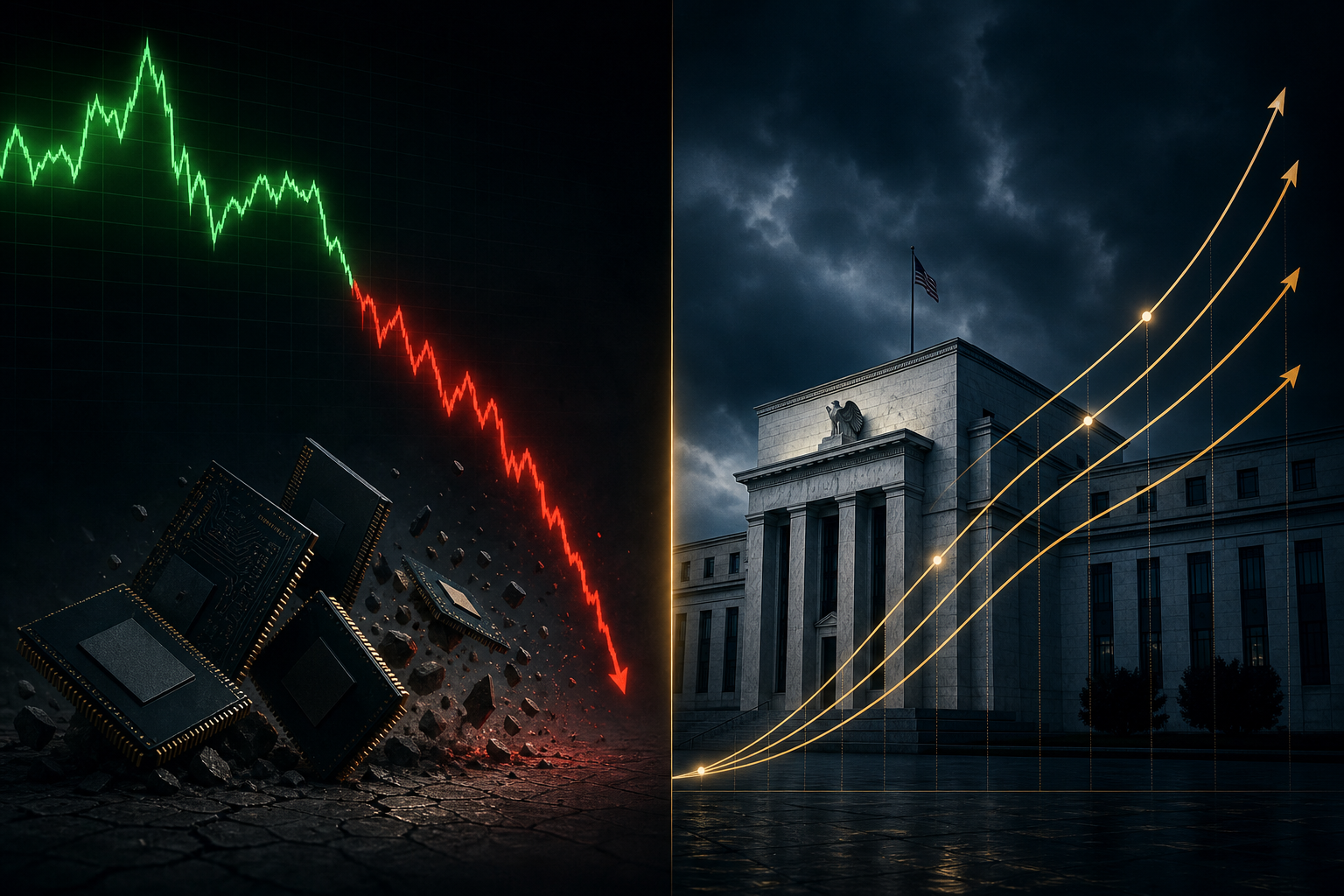
Markets entered the final week of June 2026 looking less like a celebration of technological inevitability and more like a creditor’s meeting. The Nasdaq shed roughly two percent in a single session. The Philadelphia Semiconductor Index dropped eight percent after hitting a record high one day earlier. South Korea’s KOSPI fell ten percent. Alphabet suffered its worst day in over a year. Even Nvidia gave up four percent.
This is not yet a crisis. Unemployment sits at 4.3 percent. Payroll growth surprised to the upside in May. What changed is the discount rate applied to a single story — that hundreds of billions in infrastructure spending today will compound into monopoly rents tomorrow. Capital markets are conducting an audit, and the preliminary findings are uncomfortable.
Three Forces Converged at Once
The first is AI capex skepticism. Hyperscalers are projected to spend roughly $452 billion on AI infrastructure in 2026 alone. Alphabet’s buildout, talent departures, and monetization questions triggered the initial tremor. The market is not rejecting AI; it is demanding proof that spending scales with revenue. When only a small fraction of users pay for premium products, the gap between installed capacity and commercial validation becomes the central anxiety.
The second is monetary policy repricing under Kevin Warsh. Warsh, who assumed the Fed chair in May 2026, arrives with a different hierarchy than Jerome Powell. At the June meeting, policymakers held rates steady but erased earlier signals for cuts. The dot plot now implies a median funds rate of 3.8 percent by year-end — effectively pricing a hike. The ten-year Treasury yield climbed toward 4.45 percent. For long-duration growth assets, that is the denominator, not background noise.
The third is tightening financial conditions abroad. A stronger dollar, higher U.S. yields, and falling oil — Brent touched lows not seen since the Iran war began — created a global risk-off impulse. The selloff was tech-led, but not tech-contained.
Together, these forces explain why markets feel sick while the real economy still ambulates: asset prices had outrun the cost of capital, and capital just reminded them who sets the terms.

Why This Repricing Runs Deeper Than a Bad Week
This correction matters because the AI trade migrated from equity-funded optimism to debt-assisted megaprojects. Historically, mega-cap tech funded expansion from operating cash flow. Capex consumed perhaps forty percent of free cash flow. Today, for several hyperscalers, AI spending approaches or exceeds one hundred percent. Amazon’s negative free cash flow trajectory has become an analyst focal point. Fed policy is now a primary variable in the investment thesis, not an afterthought.
Semiconductors amplify the sensitivity. The SOX more than doubled in less than two years before this week’s reversal. Chip stocks function as leveraged bets on the entire buildout narrative — when it cracks, they crack first.
Geopolitics adds a stagflationary tail risk. Markets rallied on the U.S.-Iran memorandum as Brent collapsed below eighty dollars, but energy volatility fed into the Fed’s revised inflation projections — headline CPI now expected at 3.6 percent for 2026. Neither pure growth nor pure value portfolios handle that combination gracefully.
Three Plausible Unfoldings From Here
Soft reset (most likely near term): Earnings from memory and infrastructure suppliers stabilize sentiment. The Fed hikes once, then pauses. Equities chop sideways while multiples compress ten to fifteen percent. Painful for concentrated tech holders; manageable for diversified portfolios.
Hard repricing (rising probability): Paying-customer adoption stalls while hyperscalers lever further to defend market share. Credit spreads widen. Private AI companies face down rounds. Unprofitable names suffer most; profitable infrastructure incumbents recover first.
Macro shock (lower probability, high damage): A credit event in private credit or an over-levered AI borrower coincides with sticky inflation and a Warsh Fed unwilling to pivot for market comfort. Growth and value both fall. Portfolios should insure against this even if they cannot predict it.
The through-line: the market is moving from asking “how big?” to asking “who pays?”
Best Paths for Portfolios in a Repricing Regime
Separate infrastructure from application. Picks-and-shovels companies — fabs, memory, networking, power — have tangible demand even if valuations overshot. Application-layer companies burning cash without pricing power face the steepest repricing.
Rebuild duration awareness. As terminal rate expectations rise, the present value of earnings a decade out falls. Shorter cash-flow streams — dividends, buybacks, near-term profitability — regain relative appeal.
Diversify the inflation hedge. Portfolios concentrated in nominal long bonds and long-duration tech carry the same hidden bet: that inflation and rates will cooperate. Real assets and inflation-linked securities reduce that single point of failure.
Hold liquidity as optionality. Cash is not a strategy; it is ammunition for mispricings that corrections create.

The Broader Portfolio Statement
Markets are not failing because the future got worse. They are adjusting because the future got priced.
For three years, portfolios that leaned into mega-cap technology, semiconductor concentration, and passive index exposure to the Nasdaq enjoyed a virtuous loop: earnings beats, multiple expansion, and low rates reinforcing one another. That loop is breaking — not because AI is a mirage, but because the path from capex to cash flow is longer, costlier, and more rate-sensitive than the equity market assumed.
The lesson for portfolios is older than this selloff and will outlast it: concentration is a bet, diversification is a discipline, and the cost of capital is the gravity that never permanently disappears. When narratives run ahead of balance sheets, gravity returns. It always does.
The intelligent response is not panic or denial. Audit what you own, ask which holdings require low rates to justify their prices, and rebuild margin for a world where the Fed prioritizes inflation over equity comfort. The companies that survive will convert AI spending into paying customers. The portfolios that survive will be constructed for regimes, not rallies.
In the end, a market that questions a $452 billion invoice before signing it is a market doing its job. Painful for the overextended. Healthy for everyone else.
Tags
Sources
Analysis based on June 2026 Fed policy decision, CNBC dot-plot coverage, Reuters global market reports, hyperscaler capex disclosures, and semiconductor index performance data