
Designing governance in the absence of civic nerve is not a sermon; it is a system reset. Plato’s line—“The price of apathy towards public affairs is to be ruled by evil men”—is not ancient gristle tossed to the winds. It is a blueprint for operational resilience in a world where attention is commodified, where opinion is manufactured, and where the political horizon can recede into a neutral plain of disinterest. The question for today is not whether apathy exists, but how to re-architect our cognitive and communal channels so that the price of indifference remains prohibitive to the worst kinds of governance.

Why the warning still stings is not solely because it is grim, but because it is exquisitely pragmatic. Apathy does not merely quiet dissent; it creates an unattended system that can be gamed. When citizens disengage, power consolidates not in triumph but in inertia—the slow creep of policy by default. The regime that emerges is often less a uniform ideology and more a captured equilibrium: information filtered, issues narrowed, opportunities for accountability stifled. In short, apathy is the entry point for manipulation that looks like stability.
The antidote is not a rallying cry alone but a disciplined architecture of information and participation. The framework I propose borrows from three vectors: cognitive engineering of reading, structural clarity in political discourse, and practical scaffolding for everyday civic action. The aim is to make engagement less costly, less noisy, and more consequential—without resorting to fear-mongering or superficial novelty.

First, make the why crystal, and do it early. The lede should map the trajectory: apathy as a state problem, informational disorientation as the facilitator, and re-architected public discourse as the remedy. In practice, that means every major section of discourse must echo a shared problem-solution-restatement cadence. The reader should feel a structural compass moving from problem (civic disengagement) to approach (entropy-aware communication design) to consequence (strengthened democratic norms).
Now consider the channels of information. The modern electorate consumes content at near-infinite velocity but brief attention windows. A single article must function as an information ecosystem: it must compress and expand, repeat and reformulate, and move from abstract motive to concrete steps. The method translates to four actionable cadences:
- Redundancy with precision: Use repeated cues that anchor understanding, but always with new phrasing. This minimizes memory load while maximizing recall.
- Progressive novelty: Introduce new data points or perspectives gradually, with clear buffers that translate abstract ideas into tangible examples.
- Visual and typographic offloading: Diagrams, bullet lists, and well-timed captions can carry density that prose alone would struggle to sustain.
- Recurring motifs, not verbatim repetition: Echo a key phrase or concept in varied contexts to reinforce mental models without dull repetition.
The core human insight remains steadfast: people read to predict. If you provide a trustworthy scaffolding—the title as a semantic seed, lede as a map, paragraphs that climb a predictable curve with measured novelty—readers can pre-load their mental model, reducing cognitive friction and increasing retention of core propositions.

What does effectively re-arming the citizenry look like in practice? Consider three components: media literacy, civic design, and participatory pathways.
- Media literacy becomes an operating system, not a one-off skill. It trains readers to interrogate sources, identify framing, and separate signal from noise. In writing, this translates to explicit attribution, clear problem delineation, and transparent tradeoffs.
- Civic design borrows the language of product development: user journeys, friction audits, and feedback loops. Public information becomes a service with clear entry points, measurable outcomes, and iterative improvement cycles.
- Participatory pathways convert awareness into action. The structure of discourse should invite readers to engage in concrete steps—checking a bill, attending a town hall, contributing to a community proposal—without overwhelming them with procedural complexity.
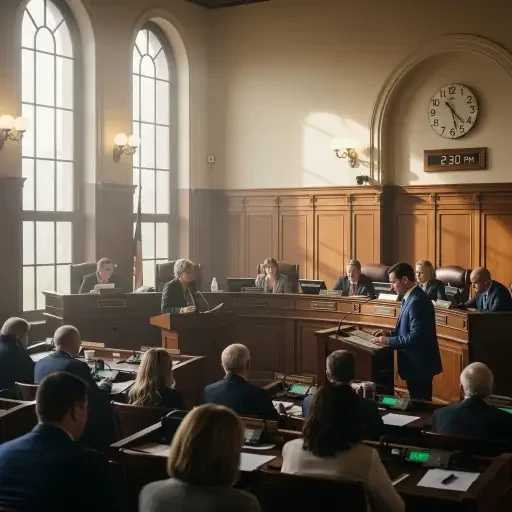
The consequences of non-action are clearest where governance intersects with ordinary life: school funding, public health, safety, and the environment. The price Plato feared is borne not by distant elites but by the grandmother who must navigate bureaucratic forms, the small business owner who bears regulatory uncertainty, the young voter whose ballot matters less because the information pipeline feels opaque. An entropy-aware approach treats these realities as design constraints: not obstacles to artful prose, but material limits to be managed.
So we end where we began, with a recursive shutdown and uplift. If apathy is the vulnerability, engagement is the shield; and the shield is built in the margins of the discourse we produce today. The article itself becomes a governance instrument: a compact that reduces the cognitive cost of comprehension while expanding the bandwidth of action. In this sense, the text ceases to be a passive object and becomes a civic tool—one that trains attention, rewards curiosity, and channels energy into policy outcomes.

In the long run, a culture that treats information as a design problem—one that prefers clarity over ambiguity, velocity over noise, feasibility over rhetoric—will see governance improved not by the force of fear but by the quiet power of understanding. Plato’s warning remains. But so does our ability to reframe the price: from a sanction on liberty to a guarantee of accountability. If we design for clarity, we design for resilience. If we design for engagement, we design for sovereignty.
Recitative endnote: The enduring lesson is simple and exact. Apathy taxes the polity; informed design defies the levy. Build systems of comprehension that move at human speed, and the political economy of attention will tilt back toward the public. The evil men—if they exist—find fewer doors to walk through, and the doors they find are fewer, narrower, and harder to open.

Tags
Related Articles
Sources
Cultural theory on political apathy, historical instances of democratic backsliding, and contemporary studies on information processing in civic contexts.