
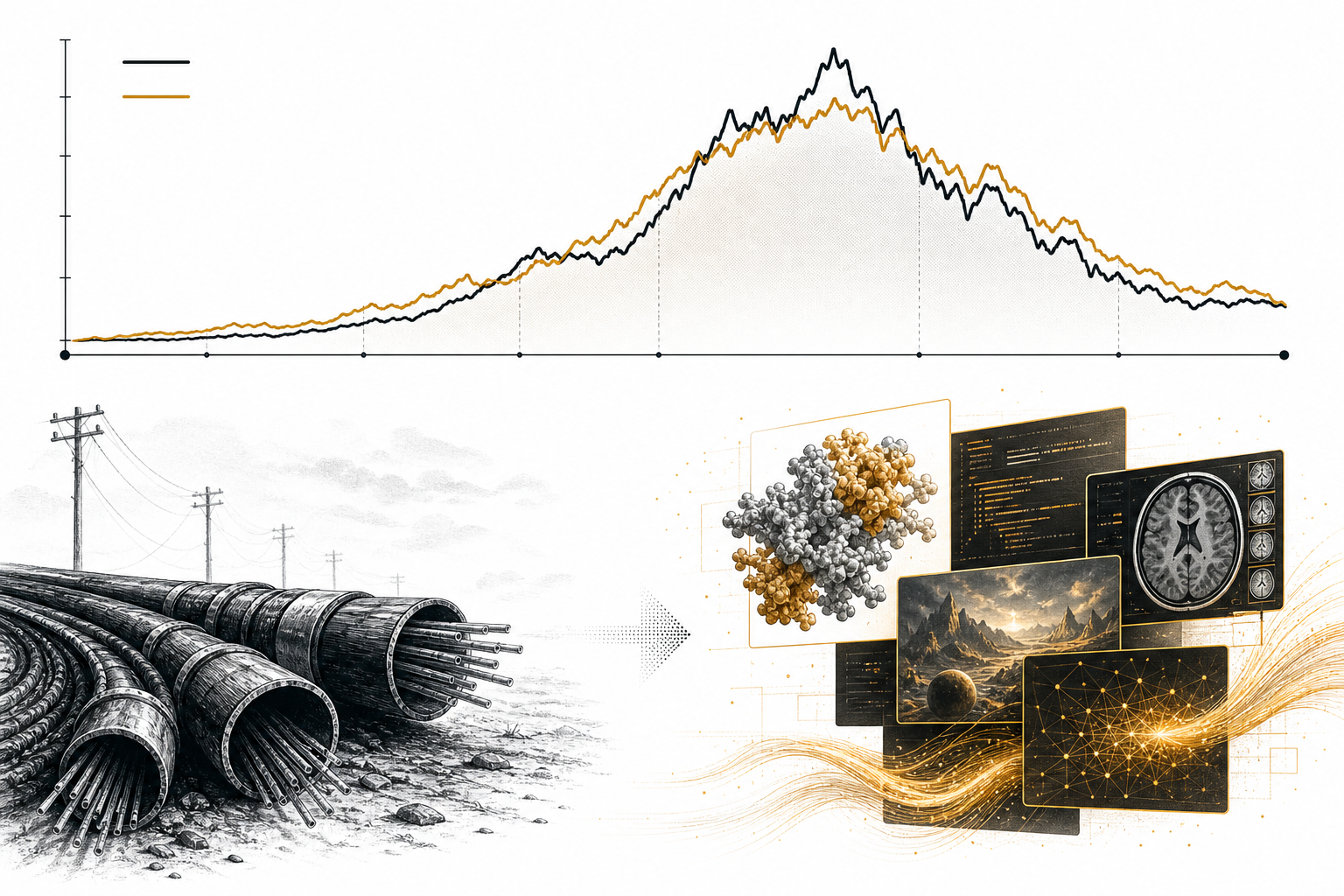
The comparison arrives on schedule. Index the telecom capital-expenditure curve from 1996 to 2001 against the hyperscaler AI curve from 2023 forward, and the first four years look uncomfortably similar — steep, synchronized, conviction-heavy. Peak telecom spending reached roughly $213 billion annually in 2000, about 1.0 to 1.2 percent of U.S. GDP. Magnificent Seven AI-related capex has already crossed 1.28 percent of GDP. Guidance for 2026 puts hyperscaler infrastructure spending near $725 billion to $775 billion — triple the inflation-adjusted telecom peak, deployed in half the elapsed time.
That is not a flicker. That is a lamppost. The question is whether the light it casts reveals a destination or a cliff.
What the Dot-Com Bust Actually Was
The late-1990s internet boom was not primarily a software story. It was a capacity story financed on hope. Carriers and backbone providers laid an estimated 80 million miles of fiber. By 2004, analysts estimated that less than five percent of that fiber was ever lit. WorldCom, Global Crossing, and dozens of peers filed for bankruptcy not because the internet failed, but because demand arrived on a slower clock than debt.
The dot-com era needed humans at every layer — engineers to lay cable, sales teams to sell bandwidth nobody yet required, analysts to model revenue from traffic that did not exist. The technology was directionally correct. The financing structure and timing were wrong. Second-wave buyers acquired the assets for pennies and built durable businesses on infrastructure the first wave could not afford to wait for.
That history matters because it defines what “bust” means: not that the underlying capability was fake, but that capital got ahead of monetization.
Why Generative AI Breaks the Old Production Function
Generative systems change the labor constraint that defined the dot-com buildout. A fiber strand carries bits; it does not produce them. A large language model or diffusion system generates outputs — code drafts, legal summaries, protein-structure predictions, radiology triage, synthetic training data — at marginal cost that collapses relative to human production.
This is not a media sideshow of images and chatbots. It is an industrial shift:
- Drug discovery pipelines that once required years of wet-lab iteration now use foundation models to screen billions of molecular candidates in silico — work that was theoretically possible pre-AI but not at the throughput or cost structure now emerging.
- Software development teams report double-digit productivity gains on routine tasks; the constraint moves from typing speed to specification quality and verification.
- Scientific simulation — weather, materials, fusion plasma — scales with compute in ways that were compute-bound before generative and agentic architectures made iteration cheap.
The dot-com boom sold connectivity. The AI boom sells cognition at scale. Connectivity without applications was dark fiber. Cognition without paying customers is still a cash burn — but the output exists the day the model trains. That is a materially different depreciation schedule for hope.
The Data That Rhymes — and the Data That Doesn’t
Rhymes: Capex intensity is at telecom-bubble levels or above. Amazon’s trailing free cash flow fell from roughly $38 billion to $1.2 billion as AI spending consumed operating cash — a 95 percent collapse that mirrors early-stage infrastructure builders, not mature platforms. Debt issuance for AI-linked projects accelerated sharply in late 2025. June 2026 brought a global tech selloff: the Nasdaq dropped more than two percent in a session, the Philadelphia Semiconductor Index fell eight percent after a record high, and South Korea’s KOSPI hit a circuit breaker on a ten percent plunge. Fed Chair Kevin Warsh’s June meeting erased cut expectations and repriced terminal rates higher. Markets are not behaving like a crowd that has fully recognized a once-in-a-millennium bargain.
Doesn’t rhyme: Aggregate hyperscaler free cash flow remains positive — unlike WorldCom-era backbone providers, which were cash-flow negative while levering into fiber. Nvidia generates tens of billions in net income on real accelerator demand. Micron’s fiscal Q3 2026 revenue hit $41.5 billion, up from $9.3 billion year-over-year, with gross margins above 81 percent and sixteen strategic customer agreements locking in roughly $100 billion in minimum revenue through take-or-pay deposits. That is not a Pets.com prospectus. That is a supplier signing contracts because buyers cannot get enough high-bandwidth memory.
The honest synthesis: the technology is further along than dot-com infrastructure was in 1999, but the financing curve is catching up to the telecom playbook faster than bulls admit.
Is This a Repricing Event of a Millennium?
The phrase tempts writers because it compresses complexity into prophecy. The data supports something more precise.
Long horizon: Productivity historians may look back at the 2020s as a regime shift comparable to electrification or the internet — a multi-decade repricing of what knowledge work costs. Generative capability plausibly justifies structurally higher returns on compute investment than dot-com bandwidth ever did, because output scales without linear headcount.
Near horizon: June 2026 is a downward repricing event, not a rush inward. Valuations had embedded low discount rates, rapid monetization, and capex that would self-fund. Warsh’s Fed, sticky inflation, and hyperscaler spending approaching 100 percent of free cash flow broke that embedding. The market is doing what it did before every major infrastructure cycle — separating builders who will survive from narratives that will not.
There is no clean evidence that equities are about to rip higher on delayed recognition of AI’s value. There is strong evidence that recognition is already underway in both directions: suppliers with contracted demand are printing record quarters while application-layer names and leveraged builders face multiple compression.
That is not millennium euphoria. It is millennium accounting — painful, selective, and overdue.
What Readers Should Actually Watch
Three indicators cut through the boom-bust rhetoric:
Capex-to-cash-flow ratio at the top four hyperscalers. If aggregate free cash flow turns persistently negative while guidance keeps rising, the telecom parallel strengthens. If cloud and AI revenue growth re-accelerates toward capex, the parallel weakens.
Paying-user conversion, not demo counts. OpenAI, Anthropic, Google, and Microsoft need premium subscriptions and enterprise contracts to scale with infrastructure — not pilot programs. The dot-com bust was lit by traffic without revenue. AI’s test is revenue without excuses.
Cost of capital. In a Warsh Fed regime with 10-year yields near 4.5 percent and rate hikes back on the table, duration is the enemy of stories. Companies that convert AI spending into near-term cash flow win. Companies that require a decade of low rates do not.

The Verdict the Data Allows
Artificial intelligence is not the dot-com bust in costume. The output is real, the supplier economics are real, and the productivity applications extend far beyond headlines about image generators. But AI is also not immune to the telecom bust’s lesson: when capex outruns cash flow and rates rise, gravity applies to every era’s miracle technology.
The market is not sleepwalking toward a delayed epiphany. It is awake, quarrelsome, and repricing in real time — rewarding Micron’s contracted memory bonanza while punishing anything that smells like leverage without customers. That is healthier than either blind panic or blind faith.
For readers and investors, the actionable frame is older than both bubbles: own the picks and shovels with purchase orders, demand proof of payment at the application layer, and treat “millennium repricing” as a decade-long process — not a trade for next quarter. The generative difference is real. So is the invoice. The dot-com ghost warns what happens when you pay the invoice before the revenue arrives.
Tags
Sources
Analysis based on telecom capex comparisons (7GC, GSMA Intelligence, Pinnacle Investments), hyperscaler guidance and capex-to-GDP data (American Century, Lead-Lag Report), June 2026 market selloff coverage, and Micron Q3 FY2026 earnings disclosures